
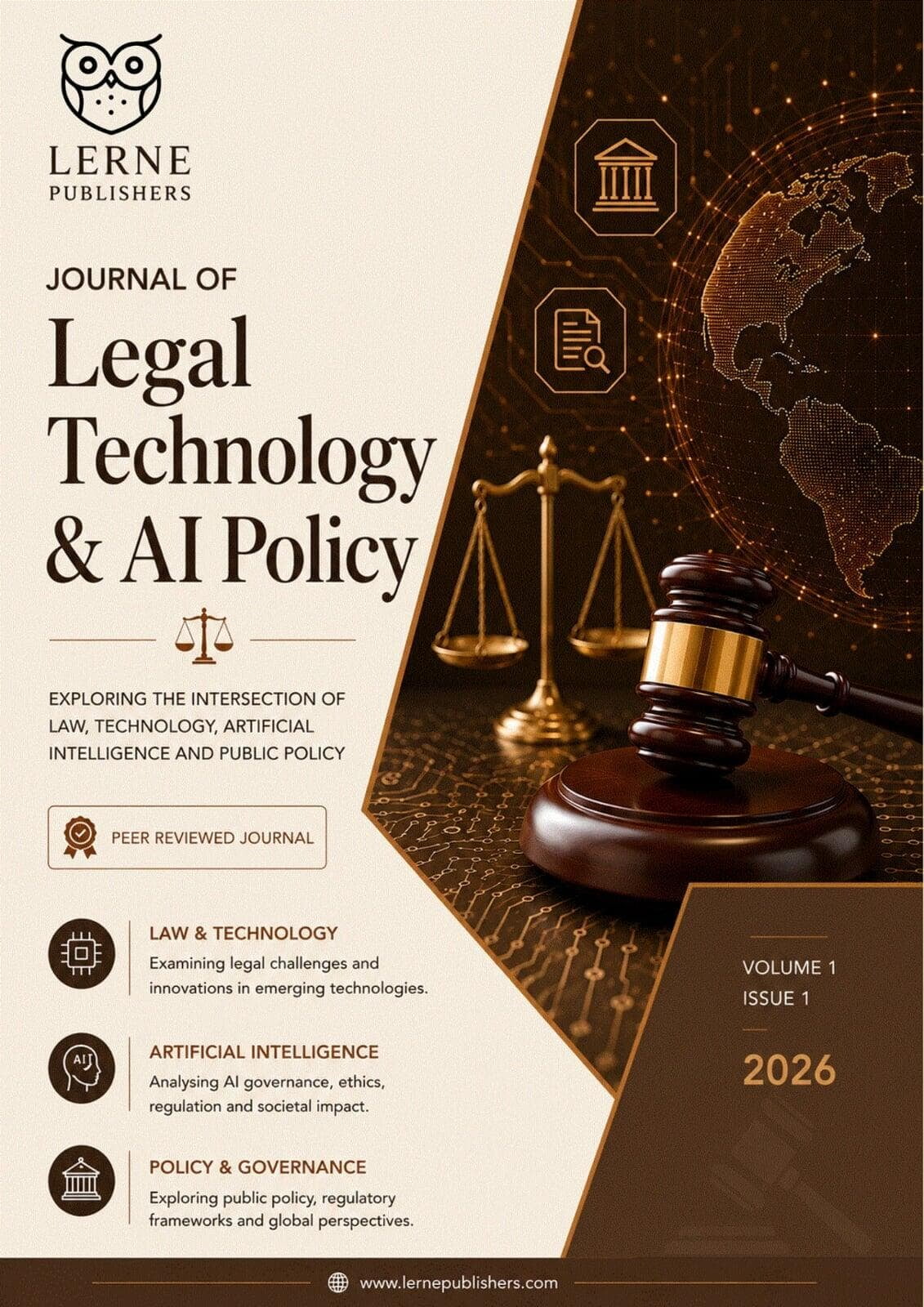
About the Journal
The Journal of Legal Technology & AI Policy is a peer-reviewed scholarly journal dedicated to exploring the evolving relationship between law, technology, artificial intelligence and public policy. The journal provides a platform for rigorous research, interdisciplinary perspectives and critical discussion on emerging technological developments and their implications for law, governance and society.
Scope of the Journal
Law and Technology
Legal challenges and innovations arising from automation, blockchain, and emerging digital transformations in legal systems.
Artificial Intelligence & Law
Covers AI governance, legal accountability, intellectual property, algorithmic bias, and AI's role in legal practice.
Data Privacy & Protection
Data protection frameworks, privacy rights, and the legal treatment of personal information in today's digital age.
Cyber Law & Digital Security
Legal responses to cybercrime, digital security threats, and the growing regulation of online spaces and digital platforms.
AI Ethics & Society
The societal impact of artificial intelligence, including fairness, accountability, and human rights in AI systems.
Digital Policy
Public policy and regulatory frameworks shaping governance of digital technologies, platforms, online ecosystems.
For Authors
What We Publish
Review Process
All submissions undergo double-blind peer review. Once submitted, your manuscript goes through editorial screening, followed by review from members of our Editorial Board, before a publication decision is made.
How To Submit?
Ready to submit? Complete the form below.
Before submitting, please review our Author Guidelines for formatting requirements, word limits, and citation style.
Editorial Board

Deborah Joanna
Editor-in-Chief
BBA.LLB., LLM.,
Legal Executive,
LifeCell International Pvt. Ltd.

Sebastian Abraham
Managing Editor
BBA.LLB., LLM.,
Research scholar,
Christ University, Bangalore.

Nandhini Sahithya
Managing Editor
BBA.LLB., LLM.,

William Wilson
UX / UI Developer
Author Guidelines
Word Count
| Type | Word Limit |
|---|---|
| Full-length articles | 5,000–8,000 words (inclusive of footnotes) |
| Case notes & commentary | 2,000–3,500 words |
| Book reviews | 1,000–1,500 words |
Formatting
- Font: Times New Roman, 12pt, double-spaced
- Margins: 1 inch on all sides
- Footnotes (not endnotes), numbered consecutively
- Manuscript file: Word (.docx) format
- Anonymize the manuscript for blind review — remove author name(s), affiliations, and identifying acknowledgments from the file itself
Citation Style
- OSCOLA (Oxford University Standard for Citation of Legal Authorities) for legal citations
- For interdisciplinary sources (policy reports, technical papers), follow OSCOLA's general referencing conventions
Structure Requirements
- Title
- Abstract (150–250 words)
- 4–6 keywords
- Main text with headings
- Full bibliography/table of authorities
Article Processing Charge (APC)
India
| Category | Fee |
|---|---|
| Students | Rs. 1,000 |
| Research Scholars | Rs. 1,500 |
| Professionals | Rs. 2,000 |
International Authors
| Category | Fee |
|---|---|
| Students | USD 25 |
| Research Scholars | USD 35 |
| Professionals | USD 50 |
- The APC applies only to manuscripts accepted for publication — there is no fee to submit a manuscript for review
- Category is determined by the corresponding author's status at the time of submission
Ethics & Originality
- Manuscripts must be original and not simultaneously under consideration elsewhere
- Plagiarism will result in immediate rejection
- Published articles are made available under a CC BY 4.0 license